Read Between the Lines
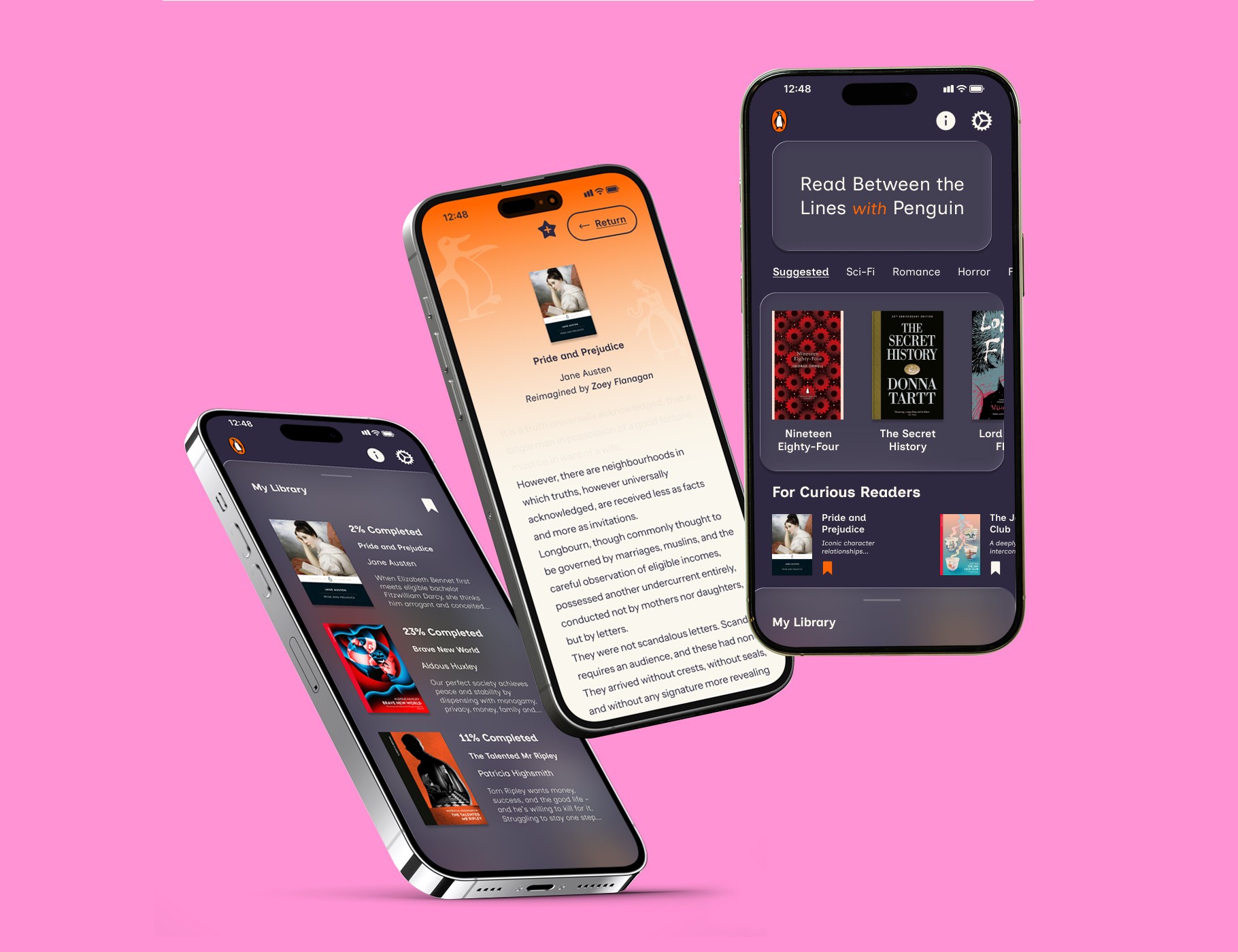
Read Between the Lines transforms reading into an interactive experience. Powered by Monotype's variable fonts, text subtly shifts to reveal hidden story paths. Tap a word to branch into secret character arcs and alternate endings, or ignore it and follow the classic story. Every page rewards curiosity, where books evolve and surprise every time they're opened.
Problem 🧩 ——
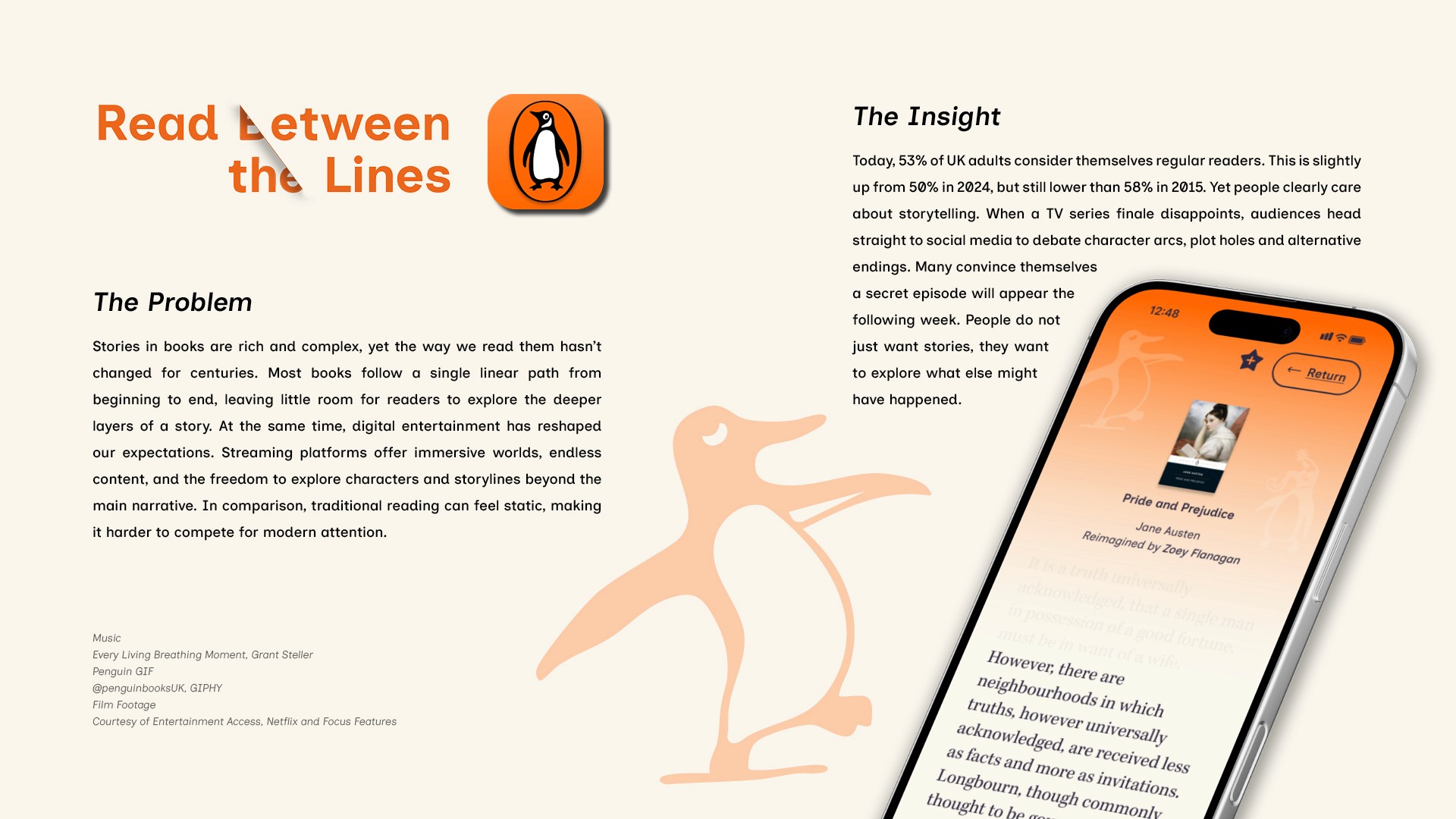
Stories in books are rich and complex, yet the way we read them hasn’t changed for centuries. Most books follow a single linear path from beginning to end, leaving little room for readers to explore the deeper layers of a story. At the same time, digital entertainment has reshaped our expectations. Streaming platforms offer immersive worlds, endless content, and the freedom to explore characters and storylines beyond the main narrative. In comparison, traditional reading can feel static, making it harder to compete for modern attention.
Insight 🔍 ——
Today, 53% of UK adults consider themselves regular readers. This is slightly up from 50% in 2024, but still lower than 58% in 2015. Yet people clearly care about storytelling. When a TV series finale disappoints, audiences head straight to social media to debate character arcs, plot holes and alternative endings. Many convince themselves a secret episode will appear the following week. People do not just want stories, they want to explore what else might have happened.
Research 📊 ——
User research showed strong curiosity towards interactive reading, with 49 per cent responding positively and 38 per cent open to trying it. Key findings included:
87 per cent found subtle text changes engaging rather than distracting
Glitch-style typography was the most effective visual cue at 62 per cent
Speed reading at around 300 words per minute was the most appealing format
Users favoured familiar, content-rich layouts for discovery
Qualitative feedback emphasised the importance of accessibility, pacing, and genre-appropriate design. Users also highlighted the need for subtlety, ensuring interactions enhance rather than disrupt the reading experience.
Solution 🚀 ——
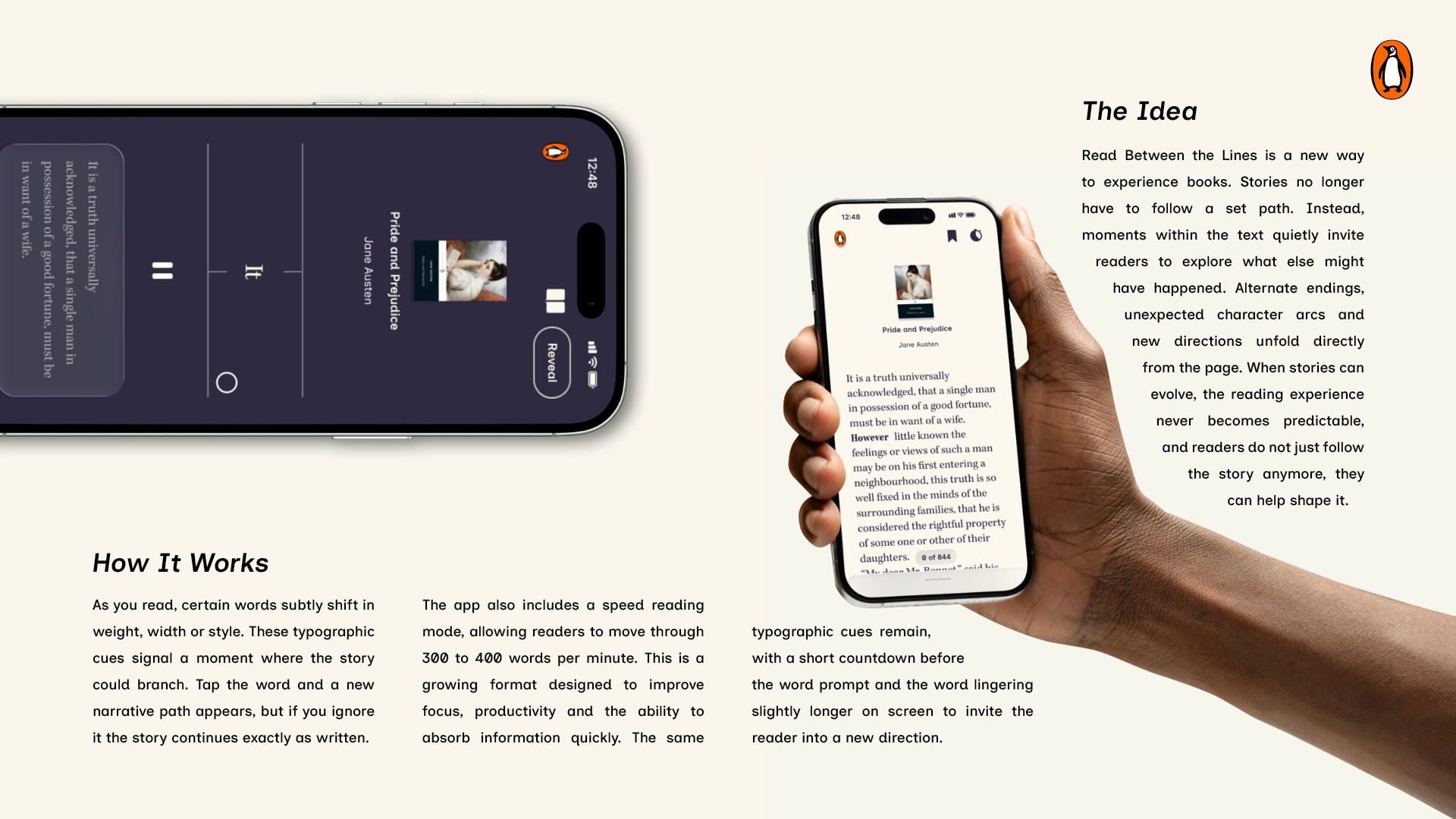
I designed Read Between the Lines, an interactive reading platform where stories evolve beyond a single narrative. Using variable font technology, certain words subtly shift in weight or style to signal hidden paths. Readers can tap these moments to unlock alternate endings, character arcs, or new directions, or continue reading uninterrupted.
The app includes a customisable reading experience, from traditional layouts to a speed reading mode of up to 300-400 words per minute, with typographic cues preserved throughout. Readers can also submit their own alternate narratives, turning reading from a static activity into an evolving ecosystem where stories expand over time.
Read Between the Lines
Insight 🔍 ——
Today, 53% of UK adults consider themselves regular readers. This is slightly up from 50% in 2024, but still lower than 58% in 2015. Yet people clearly care about storytelling. When a TV series finale disappoints, audiences head straight to social media to debate character arcs, plot holes and alternative endings. Many convince themselves a secret episode will appear the following week. People do not just want stories, they want to explore what else might have happened.
Problem 🧩 ——
Stories in books are rich and complex, yet the way we read them hasn’t changed for centuries. Most books follow a single linear path from beginning to end, leaving little room for readers to explore the deeper layers of a story. At the same time, digital entertainment has reshaped our expectations. Streaming platforms offer immersive worlds, endless content, and the freedom to explore characters and storylines beyond the main narrative. In comparison, traditional reading can feel static, making it harder to compete for modern attention.
Read Between the Lines transforms reading into an interactive experience. Powered by Monotype’s variable fonts, the text subtly shifts in weight, width and style to reveal hidden story paths. Readers can tap a word to branch the narrative into secret character arcs, alternate endings and unexpected twists, or ignore it to continue the classic story. Compose alternate narratives and submit for publication. Every page rewards curiosity, inviting readers to explore the deeper layers of a story. It’s storytelling reimagined, powered by readers, where books evolve and surprise every time they are opened.
Research 📊 ——
User research showed strong curiosity towards interactive reading, with 49 per cent responding positively and 38 per cent open to trying it. Key findings included:
87 per cent found subtle text changes engaging rather than distracting
Glitch-style typography was the most effective visual cue at 62 per cent
Speed reading at around 300 words per minute was the most appealing format
Users favoured familiar, content-rich layouts for discovery
Qualitative feedback emphasised the importance of accessibility, pacing, and genre-appropriate design. Users also highlighted the need for subtlety, ensuring interactions enhance rather than disrupt the reading experience.
Solution 🚀 ——
I designed Read Between the Lines, an interactive reading platform where stories evolve beyond a single narrative. Using variable font technology, certain words subtly shift in weight or style to signal hidden paths. Readers can tap these moments to unlock alternate endings, character arcs, or new directions, or continue reading uninterrupted.
The app includes a customisable reading experience, from traditional layouts to a speed reading mode of up to 300-400 words per minute, with typographic cues preserved throughout. Readers can also submit their own alternate narratives, turning reading from a static activity into an evolving ecosystem where stories expand over time.
Read Between the Lines
Insight 🔍 ——
Today, 53% of UK adults consider themselves regular readers. This is slightly up from 50% in 2024, but still lower than 58% in 2015. Yet people clearly care about storytelling. When a TV series finale disappoints, audiences head straight to social media to debate character arcs, plot holes and alternative endings. Many convince themselves a secret episode will appear the following week. People do not just want stories, they want to explore what else might have happened.
Problem 🧩 ——
Stories in books are rich and complex, yet the way we read them hasn’t changed for centuries. Most books follow a single linear path from beginning to end, leaving little room for readers to explore the deeper layers of a story. At the same time, digital entertainment has reshaped our expectations. Streaming platforms offer immersive worlds, endless content, and the freedom to explore characters and storylines beyond the main narrative. In comparison, traditional reading can feel static, making it harder to compete for modern attention.
Read Between the Lines transforms reading into an interactive experience. Powered by Monotype’s variable fonts, the text subtly shifts in weight, width and style to reveal hidden story paths. Readers can tap a word to branch the narrative into secret character arcs, alternate endings and unexpected twists, or ignore it to continue the classic story. Compose alternate narratives and submit for publication. Every page rewards curiosity, inviting readers to explore the deeper layers of a story. It’s storytelling reimagined, powered by readers, where books evolve and surprise every time they are opened.
Solution 🚀 ——
I designed Read Between the Lines, an interactive reading platform where stories evolve beyond a single narrative. Using variable font technology, certain words subtly shift in weight or style to signal hidden paths. Readers can tap these moments to unlock alternate endings, character arcs, or new directions, or continue reading uninterrupted.
The app includes a customisable reading experience, from traditional layouts to a speed reading mode of up to 300-400 words per minute, with typographic cues preserved throughout. Readers can also submit their own alternate narratives, turning reading from a static activity into an evolving ecosystem where stories expand over time.
Research 📊 ——
User research showed strong curiosity towards interactive reading, with 49 per cent responding positively and 38 per cent open to trying it. Key findings included:
87 per cent found subtle text changes engaging rather than distracting
Glitch-style typography was the most effective visual cue at 62 per cent
Speed reading at around 300 words per minute was the most appealing format
Users favoured familiar, content-rich layouts for discovery
Qualitative feedback emphasised the importance of accessibility, pacing, and genre-appropriate design. Users also highlighted the need for subtlety, ensuring interactions enhance rather than disrupt the reading experience.
Read Between the Lines
Read Between the Lines transforms reading into an interactive experience. Powered by Monotype's variable fonts, text subtly shifts to reveal hidden story paths. Tap a word to branch into secret character arcs and alternate endings, or ignore it and follow the classic story. Every page rewards curiosity, where books evolve and surprise every time they're opened.
Problem 🧩 ——
Stories in books are rich and complex, yet the way we read them hasn’t changed for centuries. Most books follow a single linear path from beginning to end, leaving little room for readers to explore the deeper layers of a story. At the same time, digital entertainment has reshaped our expectations. Streaming platforms offer immersive worlds, endless content, and the freedom to explore characters and storylines beyond the main narrative. In comparison, traditional reading can feel static, making it harder to compete for modern attention.
Insight 🔍 ——
Today, 53% of UK adults consider themselves regular readers. This is slightly up from 50% in 2024, but still lower than 58% in 2015. Yet people clearly care about storytelling. When a TV series finale disappoints, audiences head straight to social media to debate character arcs, plot holes and alternative endings. Many convince themselves a secret episode will appear the following week. People do not just want stories, they want to explore what else might have happened.
Research 📊 ——
User research showed strong curiosity towards interactive reading, with 49 per cent responding positively and 38 per cent open to trying it. Key findings included:
87 per cent found subtle text changes engaging rather than distracting
Glitch-style typography was the most effective visual cue at 62 per cent
Speed reading at around 300 words per minute was the most appealing format
Users favoured familiar, content-rich layouts for discovery
Qualitative feedback emphasised the importance of accessibility, pacing, and genre-appropriate design. Users also highlighted the need for subtlety, ensuring interactions enhance rather than disrupt the reading experience.
Solution 🚀 ——
I designed Read Between the Lines, an interactive reading platform where stories evolve beyond a single narrative. Using variable font technology, certain words subtly shift in weight or style to signal hidden paths. Readers can tap these moments to unlock alternate endings, character arcs, or new directions, or continue reading uninterrupted.
The app includes a customisable reading experience, from traditional layouts to a speed reading mode of up to 300-400 words per minute, with typographic cues preserved throughout. Readers can also submit their own alternate narratives, turning reading from a static activity into an evolving ecosystem where stories expand over time.
Read Between the Lines
Insight 🔍 ——
Today, 53% of UK adults consider themselves regular readers. This is slightly up from 50% in 2024, but still lower than 58% in 2015. Yet people clearly care about storytelling. When a TV series finale disappoints, audiences head straight to social media to debate character arcs, plot holes and alternative endings. Many convince themselves a secret episode will appear the following week. People do not just want stories, they want to explore what else might have happened.
Problem 🧩 ——
Stories in books are rich and complex, yet the way we read them hasn’t changed for centuries. Most books follow a single linear path from beginning to end, leaving little room for readers to explore the deeper layers of a story. At the same time, digital entertainment has reshaped our expectations. Streaming platforms offer immersive worlds, endless content, and the freedom to explore characters and storylines beyond the main narrative. In comparison, traditional reading can feel static, making it harder to compete for modern attention.
Read Between the Lines transforms reading into an interactive experience. Powered by Monotype’s variable fonts, the text subtly shifts in weight, width and style to reveal hidden story paths. Readers can tap a word to branch the narrative into secret character arcs, alternate endings and unexpected twists, or ignore it to continue the classic story. Compose alternate narratives and submit for publication. Every page rewards curiosity, inviting readers to explore the deeper layers of a story. It’s storytelling reimagined, powered by readers, where books evolve and surprise every time they are opened.
Research 📊 ——
User research showed strong curiosity towards interactive reading, with 49 per cent responding positively and 38 per cent open to trying it. Key findings included:
87 per cent found subtle text changes engaging rather than distracting
Glitch-style typography was the most effective visual cue at 62 per cent
Speed reading at around 300 words per minute was the most appealing format
Users favoured familiar, content-rich layouts for discovery
Qualitative feedback emphasised the importance of accessibility, pacing, and genre-appropriate design. Users also highlighted the need for subtlety, ensuring interactions enhance rather than disrupt the reading experience.
Solution 🚀 ——
I designed Read Between the Lines, an interactive reading platform where stories evolve beyond a single narrative. Using variable font technology, certain words subtly shift in weight or style to signal hidden paths. Readers can tap these moments to unlock alternate endings, character arcs, or new directions, or continue reading uninterrupted.
The app includes a customisable reading experience, from traditional layouts to a speed reading mode of up to 300-400 words per minute, with typographic cues preserved throughout. Readers can also submit their own alternate narratives, turning reading from a static activity into an evolving ecosystem where stories expand over time.
Read Between the Lines
Insight 🔍 ——
Today, 53% of UK adults consider themselves regular readers. This is slightly up from 50% in 2024, but still lower than 58% in 2015. Yet people clearly care about storytelling. When a TV series finale disappoints, audiences head straight to social media to debate character arcs, plot holes and alternative endings. Many convince themselves a secret episode will appear the following week. People do not just want stories, they want to explore what else might have happened.
Problem 🧩 ——
Stories in books are rich and complex, yet the way we read them hasn’t changed for centuries. Most books follow a single linear path from beginning to end, leaving little room for readers to explore the deeper layers of a story. At the same time, digital entertainment has reshaped our expectations. Streaming platforms offer immersive worlds, endless content, and the freedom to explore characters and storylines beyond the main narrative. In comparison, traditional reading can feel static, making it harder to compete for modern attention.
Read Between the Lines transforms reading into an interactive experience. Powered by Monotype’s variable fonts, the text subtly shifts in weight, width and style to reveal hidden story paths. Readers can tap a word to branch the narrative into secret character arcs, alternate endings and unexpected twists, or ignore it to continue the classic story. Compose alternate narratives and submit for publication. Every page rewards curiosity, inviting readers to explore the deeper layers of a story. It’s storytelling reimagined, powered by readers, where books evolve and surprise every time they are opened.
Solution 🚀 ——
I designed Read Between the Lines, an interactive reading platform where stories evolve beyond a single narrative. Using variable font technology, certain words subtly shift in weight or style to signal hidden paths. Readers can tap these moments to unlock alternate endings, character arcs, or new directions, or continue reading uninterrupted.
The app includes a customisable reading experience, from traditional layouts to a speed reading mode of up to 300-400 words per minute, with typographic cues preserved throughout. Readers can also submit their own alternate narratives, turning reading from a static activity into an evolving ecosystem where stories expand over time.
Research 📊 ——
User research showed strong curiosity towards interactive reading, with 49 per cent responding positively and 38 per cent open to trying it. Key findings included:
87 per cent found subtle text changes engaging rather than distracting
Glitch-style typography was the most effective visual cue at 62 per cent
Speed reading at around 300 words per minute was the most appealing format
Users favoured familiar, content-rich layouts for discovery
Qualitative feedback emphasised the importance of accessibility, pacing, and genre-appropriate design. Users also highlighted the need for subtlety, ensuring interactions enhance rather than disrupt the reading experience.
Read Between the Lines
Read Between the Lines transforms reading into an interactive experience. Powered by Monotype's variable fonts, text subtly shifts to reveal hidden story paths. Tap a word to branch into secret character arcs and alternate endings, or ignore it and follow the classic story. Every page rewards curiosity, where books evolve and surprise every time they're opened.
Problem 🧩 ——
Stories in books are rich and complex, yet the way we read them hasn’t changed for centuries. Most books follow a single linear path from beginning to end, leaving little room for readers to explore the deeper layers of a story. At the same time, digital entertainment has reshaped our expectations. Streaming platforms offer immersive worlds, endless content, and the freedom to explore characters and storylines beyond the main narrative. In comparison, traditional reading can feel static, making it harder to compete for modern attention.
Insight 🔍 ——
Today, 53% of UK adults consider themselves regular readers. This is slightly up from 50% in 2024, but still lower than 58% in 2015. Yet people clearly care about storytelling. When a TV series finale disappoints, audiences head straight to social media to debate character arcs, plot holes and alternative endings. Many convince themselves a secret episode will appear the following week. People do not just want stories, they want to explore what else might have happened.
Research 📊 ——
User research showed strong curiosity towards interactive reading, with 49 per cent responding positively and 38 per cent open to trying it. Key findings included:
87 per cent found subtle text changes engaging rather than distracting
Glitch-style typography was the most effective visual cue at 62 per cent
Speed reading at around 300 words per minute was the most appealing format
Users favoured familiar, content-rich layouts for discovery
Qualitative feedback emphasised the importance of accessibility, pacing, and genre-appropriate design. Users also highlighted the need for subtlety, ensuring interactions enhance rather than disrupt the reading experience.
Solution 🚀 ——
I designed Read Between the Lines, an interactive reading platform where stories evolve beyond a single narrative. Using variable font technology, certain words subtly shift in weight or style to signal hidden paths. Readers can tap these moments to unlock alternate endings, character arcs, or new directions, or continue reading uninterrupted.
The app includes a customisable reading experience, from traditional layouts to a speed reading mode of up to 300-400 words per minute, with typographic cues preserved throughout. Readers can also submit their own alternate narratives, turning reading from a static activity into an evolving ecosystem where stories expand over time.
Read Between the Lines
Insight 🔍 ——
Today, 53% of UK adults consider themselves regular readers. This is slightly up from 50% in 2024, but still lower than 58% in 2015. Yet people clearly care about storytelling. When a TV series finale disappoints, audiences head straight to social media to debate character arcs, plot holes and alternative endings. Many convince themselves a secret episode will appear the following week. People do not just want stories, they want to explore what else might have happened.
Problem 🧩 ——
Stories in books are rich and complex, yet the way we read them hasn’t changed for centuries. Most books follow a single linear path from beginning to end, leaving little room for readers to explore the deeper layers of a story. At the same time, digital entertainment has reshaped our expectations. Streaming platforms offer immersive worlds, endless content, and the freedom to explore characters and storylines beyond the main narrative. In comparison, traditional reading can feel static, making it harder to compete for modern attention.
Read Between the Lines transforms reading into an interactive experience. Powered by Monotype’s variable fonts, the text subtly shifts in weight, width and style to reveal hidden story paths. Readers can tap a word to branch the narrative into secret character arcs, alternate endings and unexpected twists, or ignore it to continue the classic story. Compose alternate narratives and submit for publication. Every page rewards curiosity, inviting readers to explore the deeper layers of a story. It’s storytelling reimagined, powered by readers, where books evolve and surprise every time they are opened.
Research 📊 ——
User research showed strong curiosity towards interactive reading, with 49 per cent responding positively and 38 per cent open to trying it. Key findings included:
87 per cent found subtle text changes engaging rather than distracting
Glitch-style typography was the most effective visual cue at 62 per cent
Speed reading at around 300 words per minute was the most appealing format
Users favoured familiar, content-rich layouts for discovery
Qualitative feedback emphasised the importance of accessibility, pacing, and genre-appropriate design. Users also highlighted the need for subtlety, ensuring interactions enhance rather than disrupt the reading experience.
Solution 🚀 ——
I designed Read Between the Lines, an interactive reading platform where stories evolve beyond a single narrative. Using variable font technology, certain words subtly shift in weight or style to signal hidden paths. Readers can tap these moments to unlock alternate endings, character arcs, or new directions, or continue reading uninterrupted.
The app includes a customisable reading experience, from traditional layouts to a speed reading mode of up to 300-400 words per minute, with typographic cues preserved throughout. Readers can also submit their own alternate narratives, turning reading from a static activity into an evolving ecosystem where stories expand over time.
Read Between the Lines
Insight 🔍 ——
Today, 53% of UK adults consider themselves regular readers. This is slightly up from 50% in 2024, but still lower than 58% in 2015. Yet people clearly care about storytelling. When a TV series finale disappoints, audiences head straight to social media to debate character arcs, plot holes and alternative endings. Many convince themselves a secret episode will appear the following week. People do not just want stories, they want to explore what else might have happened.
Problem 🧩 ——
Stories in books are rich and complex, yet the way we read them hasn’t changed for centuries. Most books follow a single linear path from beginning to end, leaving little room for readers to explore the deeper layers of a story. At the same time, digital entertainment has reshaped our expectations. Streaming platforms offer immersive worlds, endless content, and the freedom to explore characters and storylines beyond the main narrative. In comparison, traditional reading can feel static, making it harder to compete for modern attention.
Read Between the Lines transforms reading into an interactive experience. Powered by Monotype’s variable fonts, the text subtly shifts in weight, width and style to reveal hidden story paths. Readers can tap a word to branch the narrative into secret character arcs, alternate endings and unexpected twists, or ignore it to continue the classic story. Compose alternate narratives and submit for publication. Every page rewards curiosity, inviting readers to explore the deeper layers of a story. It’s storytelling reimagined, powered by readers, where books evolve and surprise every time they are opened.
Solution 🚀 ——
I designed Read Between the Lines, an interactive reading platform where stories evolve beyond a single narrative. Using variable font technology, certain words subtly shift in weight or style to signal hidden paths. Readers can tap these moments to unlock alternate endings, character arcs, or new directions, or continue reading uninterrupted.
The app includes a customisable reading experience, from traditional layouts to a speed reading mode of up to 300-400 words per minute, with typographic cues preserved throughout. Readers can also submit their own alternate narratives, turning reading from a static activity into an evolving ecosystem where stories expand over time.
Research 📊 ——
User research showed strong curiosity towards interactive reading, with 49 per cent responding positively and 38 per cent open to trying it. Key findings included:
87 per cent found subtle text changes engaging rather than distracting
Glitch-style typography was the most effective visual cue at 62 per cent
Speed reading at around 300 words per minute was the most appealing format
Users favoured familiar, content-rich layouts for discovery
Qualitative feedback emphasised the importance of accessibility, pacing, and genre-appropriate design. Users also highlighted the need for subtlety, ensuring interactions enhance rather than disrupt the reading experience.