Loop by Oyster Card
Loop turns everyday commuting into something more intentional. Built around the London Underground, it delivers short curated content that downloads automatically and works without signal. Podcasts, local news and short-form video fit into the natural rhythm of a journey, updating as you move through the network. Rewards unlock as you travel, offering discounts and local recommendations. Simple, relevant and effortless, adding value to time that would otherwise be lost.
Problem 🧩 ——
Commuting is often filled with empty, disconnected moments. Despite being surrounded by people, many passengers experience travel as passive and isolating, especially in signal blackspots like the Underground. Wider cultural shifts have also changed expectations of brands, with consumers increasingly seeking meaningful, value-driven experiences over transactional ones.
Transport for London plays a central role in millions of daily routines, yet the Oyster Card experience remains largely functional. It facilitates movement but does little to enrich the journey itself, creating a missed opportunity to transform otherwise lost time into something more engaging, useful, and rewarding.
Insight 🔍 ——
Commuters are not short of time, they are short of meaningful ways to use it. Research showed that 55 per cent of users frequently lose signal, with 85 per cent highlighting the Underground as the main issue. During these moments, 35 per cent stop using their phones altogether and 30 per cent switch aimlessly between apps. Despite this, 70 per cent said offline access would increase engagement, 65 per cent value relevant contextual content, and 80 per cent prefer an ad-free experience. People are open to engaging during their commute, but only if the experience feels seamless and worth their attention.
Research 📊 ——
Initial concept testing explored a tap-to-unlock content model triggered at the start of a journey. While engaging, it quickly revealed that static content lost relevance as users moved through different locations. Iterative testing led to a key shift, content should evolve alongside the journey, updating at each station to become more dynamic and context-aware.
User feedback highlighted several priorities:
Content must feel lightweight and easy to dip in and out of
Updates should feel natural within the flow of travel
Rewards are most valuable when tied to nearby locations
The experience should remain simple with no reliance on signal
These findings shaped a system that aligns with real commuting behaviour rather than interrupting it.
Solution 🚀 ——
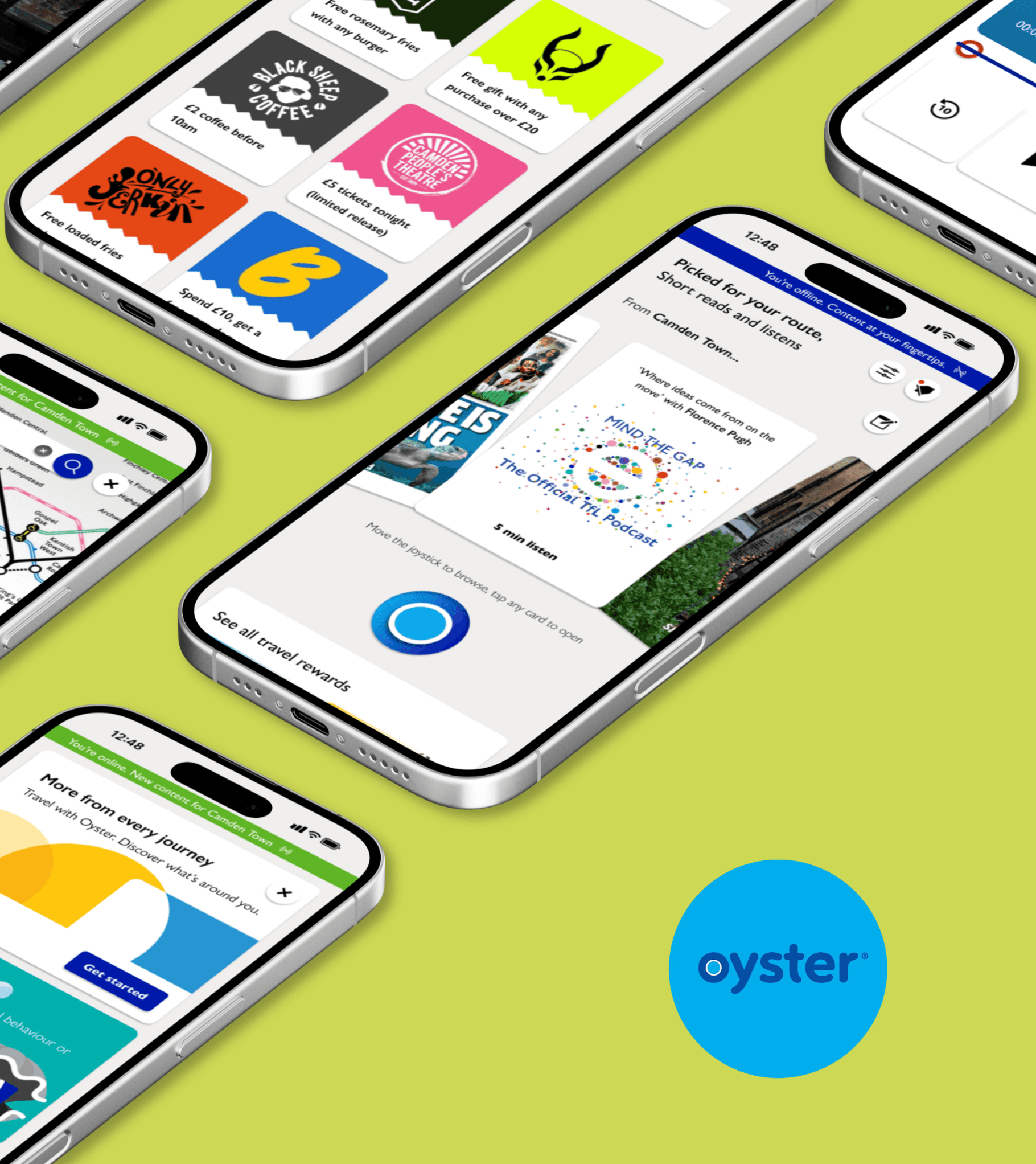
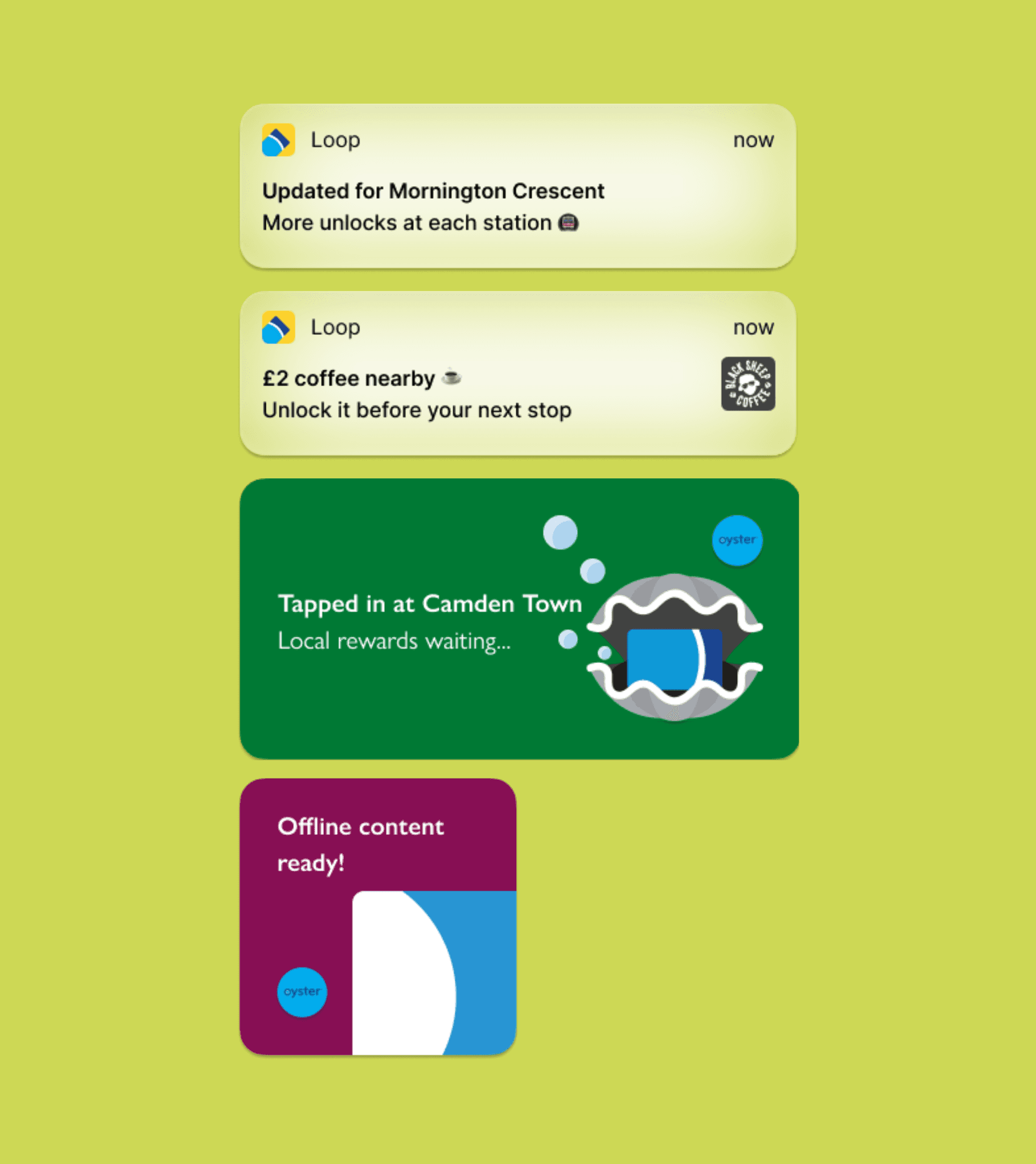
I designed Loop, an Oyster Card integrated app that turns everyday journeys into curated, evolving experiences. Content downloads automatically before travel and refreshes at each station, staying relevant and usable even without signal.
Loop delivers short-form podcasts, local news, videos and recommendations designed to fit naturally within the rhythm of a commute. Alongside content, a reward system unlocks as users travel, with offers and local recommendations adapting in real time based on location.
By shifting Oyster from a purely functional tool to a service that gives back, Loop adds value without friction and redefines commuting as an opportunity rather than a gap in the day.
"Make every journey count"
Loop by Oyster Card
Insight 🔍 ——
Commuters are not short of time, they are short of meaningful ways to use it. Research showed that 55 per cent of users frequently lose signal, with 85 per cent highlighting the Underground as the main issue. During these moments, 35 per cent stop using their phones altogether and 30 per cent switch aimlessly between apps. Despite this, 70 per cent said offline access would increase engagement, 65 per cent value relevant contextual content, and 80 per cent prefer an ad-free experience. People are open to engaging during their commute, but only if the experience feels seamless and worth their attention.
Problem 🧩 ——
Commuting is often filled with empty, disconnected moments. Despite being surrounded by people, many passengers experience travel as passive and isolating, especially in signal blackspots like the Underground. Wider cultural shifts have also changed expectations of brands, with consumers increasingly seeking meaningful, value-driven experiences over transactional ones.
Transport for London plays a central role in millions of daily routines, yet the Oyster Card experience remains largely functional. It facilitates movement but does little to enrich the journey itself, creating a missed opportunity to transform otherwise lost time into something more engaging, useful, and rewarding.
Loop turns everyday commuting into something more intentional. Built around the London Underground, it delivers short curated content that downloads automatically and works without signal. Podcasts, local news and short-form video fit into the natural rhythm of a journey, updating as you move through the network. Rewards unlock as you travel, offering discounts and local recommendations. Simple, relevant and effortless, adding value to time that would otherwise be lost.
Research 📊 ——
Initial concept testing explored a tap-to-unlock content model triggered at the start of a journey. While engaging, it quickly revealed that static content lost relevance as users moved through different locations. Iterative testing led to a key shift, content should evolve alongside the journey, updating at each station to become more dynamic and context-aware.
User feedback highlighted several priorities:
Content must feel lightweight and easy to dip in and out of
Updates should feel natural within the flow of travel
Rewards are most valuable when tied to nearby locations
The experience should remain simple with no reliance on signal
These findings shaped a system that aligns with real commuting behaviour rather than interrupting it.
Solution 🚀 ——
I designed Loop, an Oyster Card integrated app that turns everyday journeys into curated, evolving experiences. Content downloads automatically before travel and refreshes at each station, staying relevant and usable even without signal.
Loop delivers short-form podcasts, local news, videos and recommendations designed to fit naturally within the rhythm of a commute. Alongside content, a reward system unlocks as users travel, with offers and local recommendations adapting in real time based on location.
By shifting Oyster from a purely functional tool to a service that gives back, Loop adds value without friction and redefines commuting as an opportunity rather than a gap in the day.
"Make every journey count"
Loop by Oyster Card
Insight 🔍 ——
Commuters are not short of time, they are short of meaningful ways to use it. Research showed that 55 per cent of users frequently lose signal, with 85 per cent highlighting the Underground as the main issue. During these moments, 35 per cent stop using their phones altogether and 30 per cent switch aimlessly between apps. Despite this, 70 per cent said offline access would increase engagement, 65 per cent value relevant contextual content, and 80 per cent prefer an ad-free experience. People are open to engaging during their commute, but only if the experience feels seamless and worth their attention.
Problem 🧩 ——
Commuting is often filled with empty, disconnected moments. Despite being surrounded by people, many passengers experience travel as passive and isolating, especially in signal blackspots like the Underground. Wider cultural shifts have also changed expectations of brands, with consumers increasingly seeking meaningful, value-driven experiences over transactional ones.
Transport for London plays a central role in millions of daily routines, yet the Oyster Card experience remains largely functional. It facilitates movement but does little to enrich the journey itself, creating a missed opportunity to transform otherwise lost time into something more engaging, useful, and rewarding.
Loop turns everyday commuting into something more intentional. Built around the London Underground, it delivers short curated content that downloads automatically and works without signal. Podcasts, local news and short-form video fit into the natural rhythm of a journey, updating as you move through the network. Rewards unlock as you travel, offering discounts and local recommendations. Simple, relevant and effortless, adding value to time that would otherwise be lost.
Solution 🚀 ——
I designed Loop, an Oyster Card integrated app that turns everyday journeys into curated, evolving experiences. Content downloads automatically before travel and refreshes at each station, staying relevant and usable even without signal.
Loop delivers short-form podcasts, local news, videos and recommendations designed to fit naturally within the rhythm of a commute. Alongside content, a reward system unlocks as users travel, with offers and local recommendations adapting in real time based on location.
By shifting Oyster from a purely functional tool to a service that gives back, Loop adds value without friction and redefines commuting as an opportunity rather than a gap in the day.
"Make every journey count"
Research 📊 ——
Initial concept testing explored a tap-to-unlock content model triggered at the start of a journey. While engaging, it quickly revealed that static content lost relevance as users moved through different locations. Iterative testing led to a key shift, content should evolve alongside the journey, updating at each station to become more dynamic and context-aware.
User feedback highlighted several priorities:
Content must feel lightweight and easy to dip in and out of
Updates should feel natural within the flow of travel
Rewards are most valuable when tied to nearby locations
The experience should remain simple with no reliance on signal
These findings shaped a system that aligns with real commuting behaviour rather than interrupting it.
Loop by Oyster Card
Loop turns everyday commuting into something more intentional. Built around the London Underground, it delivers short curated content that downloads automatically and works without signal. Podcasts, local news and short-form video fit into the natural rhythm of a journey, updating as you move through the network. Rewards unlock as you travel, offering discounts and local recommendations. Simple, relevant and effortless, adding value to time that would otherwise be lost.
Problem 🧩 ——
Commuting is often filled with empty, disconnected moments. Despite being surrounded by people, many passengers experience travel as passive and isolating, especially in signal blackspots like the Underground. Wider cultural shifts have also changed expectations of brands, with consumers increasingly seeking meaningful, value-driven experiences over transactional ones.
Transport for London plays a central role in millions of daily routines, yet the Oyster Card experience remains largely functional. It facilitates movement but does little to enrich the journey itself, creating a missed opportunity to transform otherwise lost time into something more engaging, useful, and rewarding.
Insight 🔍 ——
Commuters are not short of time, they are short of meaningful ways to use it. Research showed that 55 per cent of users frequently lose signal, with 85 per cent highlighting the Underground as the main issue. During these moments, 35 per cent stop using their phones altogether and 30 per cent switch aimlessly between apps. Despite this, 70 per cent said offline access would increase engagement, 65 per cent value relevant contextual content, and 80 per cent prefer an ad-free experience. People are open to engaging during their commute, but only if the experience feels seamless and worth their attention.
Research 📊 ——
Initial concept testing explored a tap-to-unlock content model triggered at the start of a journey. While engaging, it quickly revealed that static content lost relevance as users moved through different locations. Iterative testing led to a key shift, content should evolve alongside the journey, updating at each station to become more dynamic and context-aware.
User feedback highlighted several priorities:
Content must feel lightweight and easy to dip in and out of
Updates should feel natural within the flow of travel
Rewards are most valuable when tied to nearby locations
The experience should remain simple with no reliance on signal
These findings shaped a system that aligns with real commuting behaviour rather than interrupting it.
Solution 🚀 ——
I designed Loop, an Oyster Card integrated app that turns everyday journeys into curated, evolving experiences. Content downloads automatically before travel and refreshes at each station, staying relevant and usable even without signal.
Loop delivers short-form podcasts, local news, videos and recommendations designed to fit naturally within the rhythm of a commute. Alongside content, a reward system unlocks as users travel, with offers and local recommendations adapting in real time based on location.
By shifting Oyster from a purely functional tool to a service that gives back, Loop adds value without friction and redefines commuting as an opportunity rather than a gap in the day.
"Make every journey count"
Loop by Oyster Card
Insight 🔍 ——
Commuters are not short of time, they are short of meaningful ways to use it. Research showed that 55 per cent of users frequently lose signal, with 85 per cent highlighting the Underground as the main issue. During these moments, 35 per cent stop using their phones altogether and 30 per cent switch aimlessly between apps. Despite this, 70 per cent said offline access would increase engagement, 65 per cent value relevant contextual content, and 80 per cent prefer an ad-free experience. People are open to engaging during their commute, but only if the experience feels seamless and worth their attention.
Problem 🧩 ——
Commuting is often filled with empty, disconnected moments. Despite being surrounded by people, many passengers experience travel as passive and isolating, especially in signal blackspots like the Underground. Wider cultural shifts have also changed expectations of brands, with consumers increasingly seeking meaningful, value-driven experiences over transactional ones.
Transport for London plays a central role in millions of daily routines, yet the Oyster Card experience remains largely functional. It facilitates movement but does little to enrich the journey itself, creating a missed opportunity to transform otherwise lost time into something more engaging, useful, and rewarding.
Loop turns everyday commuting into something more intentional. Built around the London Underground, it delivers short curated content that downloads automatically and works without signal. Podcasts, local news and short-form video fit into the natural rhythm of a journey, updating as you move through the network. Rewards unlock as you travel, offering discounts and local recommendations. Simple, relevant and effortless, adding value to time that would otherwise be lost.
Research 📊 ——
Initial concept testing explored a tap-to-unlock content model triggered at the start of a journey. While engaging, it quickly revealed that static content lost relevance as users moved through different locations. Iterative testing led to a key shift, content should evolve alongside the journey, updating at each station to become more dynamic and context-aware.
User feedback highlighted several priorities:
Content must feel lightweight and easy to dip in and out of
Updates should feel natural within the flow of travel
Rewards are most valuable when tied to nearby locations
The experience should remain simple with no reliance on signal
These findings shaped a system that aligns with real commuting behaviour rather than interrupting it.
Solution 🚀 ——
I designed Loop, an Oyster Card integrated app that turns everyday journeys into curated, evolving experiences. Content downloads automatically before travel and refreshes at each station, staying relevant and usable even without signal.
Loop delivers short-form podcasts, local news, videos and recommendations designed to fit naturally within the rhythm of a commute. Alongside content, a reward system unlocks as users travel, with offers and local recommendations adapting in real time based on location.
By shifting Oyster from a purely functional tool to a service that gives back, Loop adds value without friction and redefines commuting as an opportunity rather than a gap in the day.
"Make every journey count"
Loop by Oyster Card
Insight 🔍 ——
Commuters are not short of time, they are short of meaningful ways to use it. Research showed that 55 per cent of users frequently lose signal, with 85 per cent highlighting the Underground as the main issue. During these moments, 35 per cent stop using their phones altogether and 30 per cent switch aimlessly between apps. Despite this, 70 per cent said offline access would increase engagement, 65 per cent value relevant contextual content, and 80 per cent prefer an ad-free experience. People are open to engaging during their commute, but only if the experience feels seamless and worth their attention.
Problem 🧩 ——
Commuting is often filled with empty, disconnected moments. Despite being surrounded by people, many passengers experience travel as passive and isolating, especially in signal blackspots like the Underground. Wider cultural shifts have also changed expectations of brands, with consumers increasingly seeking meaningful, value-driven experiences over transactional ones.
Transport for London plays a central role in millions of daily routines, yet the Oyster Card experience remains largely functional. It facilitates movement but does little to enrich the journey itself, creating a missed opportunity to transform otherwise lost time into something more engaging, useful, and rewarding.
Loop turns everyday commuting into something more intentional. Built around the London Underground, it delivers short curated content that downloads automatically and works without signal. Podcasts, local news and short-form video fit into the natural rhythm of a journey, updating as you move through the network. Rewards unlock as you travel, offering discounts and local recommendations. Simple, relevant and effortless, adding value to time that would otherwise be lost.
Solution 🚀 ——
I designed Loop, an Oyster Card integrated app that turns everyday journeys into curated, evolving experiences. Content downloads automatically before travel and refreshes at each station, staying relevant and usable even without signal.
Loop delivers short-form podcasts, local news, videos and recommendations designed to fit naturally within the rhythm of a commute. Alongside content, a reward system unlocks as users travel, with offers and local recommendations adapting in real time based on location.
By shifting Oyster from a purely functional tool to a service that gives back, Loop adds value without friction and redefines commuting as an opportunity rather than a gap in the day.
"Make every journey count"
Research 📊 ——
Initial concept testing explored a tap-to-unlock content model triggered at the start of a journey. While engaging, it quickly revealed that static content lost relevance as users moved through different locations. Iterative testing led to a key shift, content should evolve alongside the journey, updating at each station to become more dynamic and context-aware.
User feedback highlighted several priorities:
Content must feel lightweight and easy to dip in and out of
Updates should feel natural within the flow of travel
Rewards are most valuable when tied to nearby locations
The experience should remain simple with no reliance on signal
These findings shaped a system that aligns with real commuting behaviour rather than interrupting it.
Loop by Oyster Card
Loop turns everyday commuting into something more intentional. Built around the London Underground, it delivers short curated content that downloads automatically and works without signal. Podcasts, local news and short-form video fit into the natural rhythm of a journey, updating as you move through the network. Rewards unlock as you travel, offering discounts and local recommendations. Simple, relevant and effortless, adding value to time that would otherwise be lost.
Problem 🧩 ——
Commuting is often filled with empty, disconnected moments. Despite being surrounded by people, many passengers experience travel as passive and isolating, especially in signal blackspots like the Underground. Wider cultural shifts have also changed expectations of brands, with consumers increasingly seeking meaningful, value-driven experiences over transactional ones.
Transport for London plays a central role in millions of daily routines, yet the Oyster Card experience remains largely functional. It facilitates movement but does little to enrich the journey itself, creating a missed opportunity to transform otherwise lost time into something more engaging, useful, and rewarding.
Insight 🔍 ——
Commuters are not short of time, they are short of meaningful ways to use it. Research showed that 55 per cent of users frequently lose signal, with 85 per cent highlighting the Underground as the main issue. During these moments, 35 per cent stop using their phones altogether and 30 per cent switch aimlessly between apps. Despite this, 70 per cent said offline access would increase engagement, 65 per cent value relevant contextual content, and 80 per cent prefer an ad-free experience. People are open to engaging during their commute, but only if the experience feels seamless and worth their attention.
Research 📊 ——
Initial concept testing explored a tap-to-unlock content model triggered at the start of a journey. While engaging, it quickly revealed that static content lost relevance as users moved through different locations. Iterative testing led to a key shift, content should evolve alongside the journey, updating at each station to become more dynamic and context-aware.
User feedback highlighted several priorities:
Content must feel lightweight and easy to dip in and out of
Updates should feel natural within the flow of travel
Rewards are most valuable when tied to nearby locations
The experience should remain simple with no reliance on signal
These findings shaped a system that aligns with real commuting behaviour rather than interrupting it.
Solution 🚀 ——
I designed Loop, an Oyster Card integrated app that turns everyday journeys into curated, evolving experiences. Content downloads automatically before travel and refreshes at each station, staying relevant and usable even without signal.
Loop delivers short-form podcasts, local news, videos and recommendations designed to fit naturally within the rhythm of a commute. Alongside content, a reward system unlocks as users travel, with offers and local recommendations adapting in real time based on location.
By shifting Oyster from a purely functional tool to a service that gives back, Loop adds value without friction and redefines commuting as an opportunity rather than a gap in the day.
"Make every journey count"
Loop by Oyster Card
Insight 🔍 ——
Commuters are not short of time, they are short of meaningful ways to use it. Research showed that 55 per cent of users frequently lose signal, with 85 per cent highlighting the Underground as the main issue. During these moments, 35 per cent stop using their phones altogether and 30 per cent switch aimlessly between apps. Despite this, 70 per cent said offline access would increase engagement, 65 per cent value relevant contextual content, and 80 per cent prefer an ad-free experience. People are open to engaging during their commute, but only if the experience feels seamless and worth their attention.
Problem 🧩 ——
Commuting is often filled with empty, disconnected moments. Despite being surrounded by people, many passengers experience travel as passive and isolating, especially in signal blackspots like the Underground. Wider cultural shifts have also changed expectations of brands, with consumers increasingly seeking meaningful, value-driven experiences over transactional ones.
Transport for London plays a central role in millions of daily routines, yet the Oyster Card experience remains largely functional. It facilitates movement but does little to enrich the journey itself, creating a missed opportunity to transform otherwise lost time into something more engaging, useful, and rewarding.
Loop turns everyday commuting into something more intentional. Built around the London Underground, it delivers short curated content that downloads automatically and works without signal. Podcasts, local news and short-form video fit into the natural rhythm of a journey, updating as you move through the network. Rewards unlock as you travel, offering discounts and local recommendations. Simple, relevant and effortless, adding value to time that would otherwise be lost.
Research 📊 ——
Initial concept testing explored a tap-to-unlock content model triggered at the start of a journey. While engaging, it quickly revealed that static content lost relevance as users moved through different locations. Iterative testing led to a key shift, content should evolve alongside the journey, updating at each station to become more dynamic and context-aware.
User feedback highlighted several priorities:
Content must feel lightweight and easy to dip in and out of
Updates should feel natural within the flow of travel
Rewards are most valuable when tied to nearby locations
The experience should remain simple with no reliance on signal
These findings shaped a system that aligns with real commuting behaviour rather than interrupting it.
Solution 🚀 ——
I designed Loop, an Oyster Card integrated app that turns everyday journeys into curated, evolving experiences. Content downloads automatically before travel and refreshes at each station, staying relevant and usable even without signal.
Loop delivers short-form podcasts, local news, videos and recommendations designed to fit naturally within the rhythm of a commute. Alongside content, a reward system unlocks as users travel, with offers and local recommendations adapting in real time based on location.
By shifting Oyster from a purely functional tool to a service that gives back, Loop adds value without friction and redefines commuting as an opportunity rather than a gap in the day.
"Make every journey count"
Loop by Oyster Card
Insight 🔍 ——
Commuters are not short of time, they are short of meaningful ways to use it. Research showed that 55 per cent of users frequently lose signal, with 85 per cent highlighting the Underground as the main issue. During these moments, 35 per cent stop using their phones altogether and 30 per cent switch aimlessly between apps. Despite this, 70 per cent said offline access would increase engagement, 65 per cent value relevant contextual content, and 80 per cent prefer an ad-free experience. People are open to engaging during their commute, but only if the experience feels seamless and worth their attention.
Problem 🧩 ——
Commuting is often filled with empty, disconnected moments. Despite being surrounded by people, many passengers experience travel as passive and isolating, especially in signal blackspots like the Underground. Wider cultural shifts have also changed expectations of brands, with consumers increasingly seeking meaningful, value-driven experiences over transactional ones.
Transport for London plays a central role in millions of daily routines, yet the Oyster Card experience remains largely functional. It facilitates movement but does little to enrich the journey itself, creating a missed opportunity to transform otherwise lost time into something more engaging, useful, and rewarding.
Loop turns everyday commuting into something more intentional. Built around the London Underground, it delivers short curated content that downloads automatically and works without signal. Podcasts, local news and short-form video fit into the natural rhythm of a journey, updating as you move through the network. Rewards unlock as you travel, offering discounts and local recommendations. Simple, relevant and effortless, adding value to time that would otherwise be lost.
Solution 🚀 ——
I designed Loop, an Oyster Card integrated app that turns everyday journeys into curated, evolving experiences. Content downloads automatically before travel and refreshes at each station, staying relevant and usable even without signal.
Loop delivers short-form podcasts, local news, videos and recommendations designed to fit naturally within the rhythm of a commute. Alongside content, a reward system unlocks as users travel, with offers and local recommendations adapting in real time based on location.
By shifting Oyster from a purely functional tool to a service that gives back, Loop adds value without friction and redefines commuting as an opportunity rather than a gap in the day.
"Make every journey count"
Research 📊 ——
Initial concept testing explored a tap-to-unlock content model triggered at the start of a journey. While engaging, it quickly revealed that static content lost relevance as users moved through different locations. Iterative testing led to a key shift, content should evolve alongside the journey, updating at each station to become more dynamic and context-aware.
User feedback highlighted several priorities:
Content must feel lightweight and easy to dip in and out of
Updates should feel natural within the flow of travel
Rewards are most valuable when tied to nearby locations
The experience should remain simple with no reliance on signal
These findings shaped a system that aligns with real commuting behaviour rather than interrupting it.