The Spectrum of Play
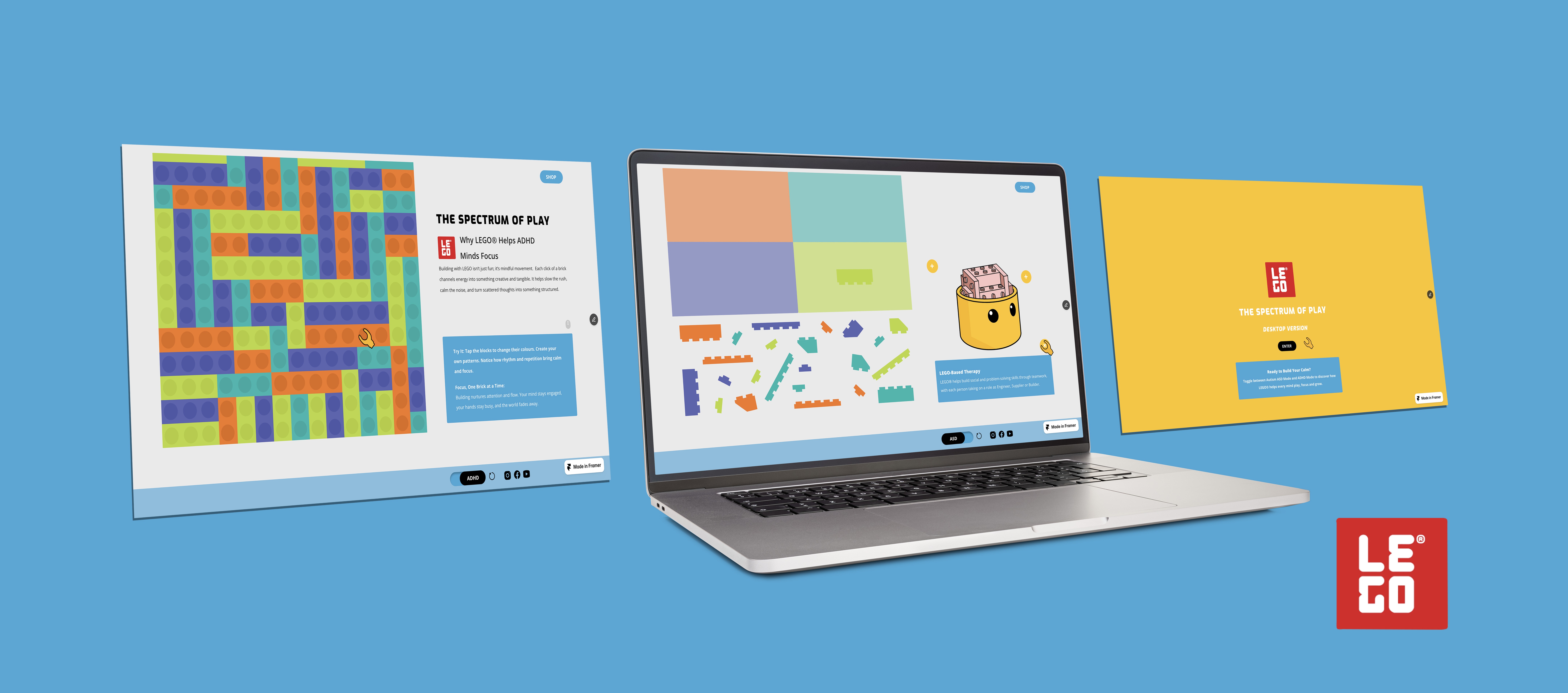
An interactive microsite (not mobile compatible) exploring how LEGO supports neurodivergent children and adults with ASD and ADHD. Users can switch between both modes to learn key facts while engaging in playful, hands-on activities like sorting bricks and creating patterns. Designed to educate, include and encourage exploration through play.
Problem 🧩 ——
Many people are aware of LEGO therapy, but most information about it is written for professionals or presented in dense academic formats. This makes it less accessible to neurodivergent children, adults, and wider audiences who could benefit from understanding how structured play supports development and wellbeing. The challenge was to communicate these benefits in a way that felt engaging, inclusive, and easy to explore.
Insight 🔍 ——
Structured, predictable play can significantly support communication, confidence, and cognitive development in individuals with ASD and ADHD. Research shows that LEGO based therapy has reported up to 97 per cent improvement in social and communication skills in children and adolescents. Users benefit from clear roles, repeatable systems, and low pressure environments where there is no right or wrong outcome. Play becomes most effective when it reduces cognitive load, supports self regulation, and encourages collaboration without overwhelming sensory input.
Research 📊 ——
Research across 15 studies involving 293 participants aged 5 to 16 found that 14 reported measurable improvements in social interaction and communication, including stronger friendships and reduced isolated play. A trial conducted across 98 schools between 2017 and 2019 showed significant long term improvements after at least six sessions, with 93 per cent of groups receiving the minimum recommended dose. Peer supported sessions demonstrated success in 5 out of 6 participants, and a three year study reported greater social skill development compared to alternative therapies. Research with autistic adults also identified anxiety reduction as a key benefit, with 20 per cent reporting reduced anxiety and 7 per cent describing the experience as meditative.
Solution 🚀 ——
I designed an interactive microsite that explores how LEGO supports neurodivergent children and adults through structured, creative play. Users can switch between ASD and ADHD modes to discover key facts while engaging in hands on activities such as sorting bricks and building patterns. Instead of explaining therapy through long form text, the experience demonstrates its benefits through interaction. The microsite is intentionally calm, accessible, and pressure free, using simple layouts, clear feedback, and optional interaction to create a focused environment that encourages exploration and learning.
The Spectrum of Play
Insight 🔍 ——
Structured, predictable play can significantly support communication, confidence, and cognitive development in individuals with ASD and ADHD. Research shows that LEGO based therapy has reported up to 97 per cent improvement in social and communication skills in children and adolescents. Users benefit from clear roles, repeatable systems, and low pressure environments where there is no right or wrong outcome. Play becomes most effective when it reduces cognitive load, supports self regulation, and encourages collaboration without overwhelming sensory input.
Problem 🧩 ——
Many people are aware of LEGO therapy, but most information about it is written for professionals or presented in dense academic formats. This makes it less accessible to neurodivergent children, adults, and wider audiences who could benefit from understanding how structured play supports development and wellbeing. The challenge was to communicate these benefits in a way that felt engaging, inclusive, and easy to explore.
An interactive microsite (not mobile compatible) exploring how LEGO supports neurodivergent children and adults with ASD and ADHD. Users can switch between both modes to learn key facts while engaging in playful, hands-on activities like sorting bricks and creating patterns. Designed to educate, include and encourage exploration through play.
Research 📊 ——
Research across 15 studies involving 293 participants aged 5 to 16 found that 14 reported measurable improvements in social interaction and communication, including stronger friendships and reduced isolated play. A trial conducted across 98 schools between 2017 and 2019 showed significant long term improvements after at least six sessions, with 93 per cent of groups receiving the minimum recommended dose. Peer supported sessions demonstrated success in 5 out of 6 participants, and a three year study reported greater social skill development compared to alternative therapies. Research with autistic adults also identified anxiety reduction as a key benefit, with 20 per cent reporting reduced anxiety and 7 per cent describing the experience as meditative.
Solution 🚀 ——
I designed an interactive microsite that explores how LEGO supports neurodivergent children and adults through structured, creative play. Users can switch between ASD and ADHD modes to discover key facts while engaging in hands on activities such as sorting bricks and building patterns. Instead of explaining therapy through long form text, the experience demonstrates its benefits through interaction. The microsite is intentionally calm, accessible, and pressure free, using simple layouts, clear feedback, and optional interaction to create a focused environment that encourages exploration and learning.
The Spectrum of Play
Insight 🔍 ——
Structured, predictable play can significantly support communication, confidence, and cognitive development in individuals with ASD and ADHD. Research shows that LEGO based therapy has reported up to 97 per cent improvement in social and communication skills in children and adolescents. Users benefit from clear roles, repeatable systems, and low pressure environments where there is no right or wrong outcome. Play becomes most effective when it reduces cognitive load, supports self regulation, and encourages collaboration without overwhelming sensory input.
Problem 🧩 ——
Many people are aware of LEGO therapy, but most information about it is written for professionals or presented in dense academic formats. This makes it less accessible to neurodivergent children, adults, and wider audiences who could benefit from understanding how structured play supports development and wellbeing. The challenge was to communicate these benefits in a way that felt engaging, inclusive, and easy to explore.
An interactive microsite (not mobile compatible) exploring how LEGO supports neurodivergent children and adults with ASD and ADHD. Users can switch between both modes to learn key facts while engaging in playful, hands-on activities like sorting bricks and creating patterns. Designed to educate, include and encourage exploration through play.
Solution 🚀 ——
I designed an interactive microsite that explores how LEGO supports neurodivergent children and adults through structured, creative play. Users can switch between ASD and ADHD modes to discover key facts while engaging in hands on activities such as sorting bricks and building patterns. Instead of explaining therapy through long form text, the experience demonstrates its benefits through interaction. The microsite is intentionally calm, accessible, and pressure free, using simple layouts, clear feedback, and optional interaction to create a focused environment that encourages exploration and learning.
Research 📊 ——
Research across 15 studies involving 293 participants aged 5 to 16 found that 14 reported measurable improvements in social interaction and communication, including stronger friendships and reduced isolated play. A trial conducted across 98 schools between 2017 and 2019 showed significant long term improvements after at least six sessions, with 93 per cent of groups receiving the minimum recommended dose. Peer supported sessions demonstrated success in 5 out of 6 participants, and a three year study reported greater social skill development compared to alternative therapies. Research with autistic adults also identified anxiety reduction as a key benefit, with 20 per cent reporting reduced anxiety and 7 per cent describing the experience as meditative.
The Spectrum of Play
An interactive microsite (not mobile compatible) exploring how LEGO supports neurodivergent children and adults with ASD and ADHD. Users can switch between both modes to learn key facts while engaging in playful, hands-on activities like sorting bricks and creating patterns. Designed to educate, include and encourage exploration through play.
Problem 🧩 ——
Many people are aware of LEGO therapy, but most information about it is written for professionals or presented in dense academic formats. This makes it less accessible to neurodivergent children, adults, and wider audiences who could benefit from understanding how structured play supports development and wellbeing. The challenge was to communicate these benefits in a way that felt engaging, inclusive, and easy to explore.
Insight 🔍 ——
Structured, predictable play can significantly support communication, confidence, and cognitive development in individuals with ASD and ADHD. Research shows that LEGO based therapy has reported up to 97 per cent improvement in social and communication skills in children and adolescents. Users benefit from clear roles, repeatable systems, and low pressure environments where there is no right or wrong outcome. Play becomes most effective when it reduces cognitive load, supports self regulation, and encourages collaboration without overwhelming sensory input.
Research 📊 ——
Research across 15 studies involving 293 participants aged 5 to 16 found that 14 reported measurable improvements in social interaction and communication, including stronger friendships and reduced isolated play. A trial conducted across 98 schools between 2017 and 2019 showed significant long term improvements after at least six sessions, with 93 per cent of groups receiving the minimum recommended dose. Peer supported sessions demonstrated success in 5 out of 6 participants, and a three year study reported greater social skill development compared to alternative therapies. Research with autistic adults also identified anxiety reduction as a key benefit, with 20 per cent reporting reduced anxiety and 7 per cent describing the experience as meditative.
Solution 🚀 ——
I designed an interactive microsite that explores how LEGO supports neurodivergent children and adults through structured, creative play. Users can switch between ASD and ADHD modes to discover key facts while engaging in hands on activities such as sorting bricks and building patterns. Instead of explaining therapy through long form text, the experience demonstrates its benefits through interaction. The microsite is intentionally calm, accessible, and pressure free, using simple layouts, clear feedback, and optional interaction to create a focused environment that encourages exploration and learning.
The Spectrum of Play
Insight 🔍 ——
Structured, predictable play can significantly support communication, confidence, and cognitive development in individuals with ASD and ADHD. Research shows that LEGO based therapy has reported up to 97 per cent improvement in social and communication skills in children and adolescents. Users benefit from clear roles, repeatable systems, and low pressure environments where there is no right or wrong outcome. Play becomes most effective when it reduces cognitive load, supports self regulation, and encourages collaboration without overwhelming sensory input.
Problem 🧩 ——
Many people are aware of LEGO therapy, but most information about it is written for professionals or presented in dense academic formats. This makes it less accessible to neurodivergent children, adults, and wider audiences who could benefit from understanding how structured play supports development and wellbeing. The challenge was to communicate these benefits in a way that felt engaging, inclusive, and easy to explore.
An interactive microsite (not mobile compatible) exploring how LEGO supports neurodivergent children and adults with ASD and ADHD. Users can switch between both modes to learn key facts while engaging in playful, hands-on activities like sorting bricks and creating patterns. Designed to educate, include and encourage exploration through play.
Research 📊 ——
Research across 15 studies involving 293 participants aged 5 to 16 found that 14 reported measurable improvements in social interaction and communication, including stronger friendships and reduced isolated play. A trial conducted across 98 schools between 2017 and 2019 showed significant long term improvements after at least six sessions, with 93 per cent of groups receiving the minimum recommended dose. Peer supported sessions demonstrated success in 5 out of 6 participants, and a three year study reported greater social skill development compared to alternative therapies. Research with autistic adults also identified anxiety reduction as a key benefit, with 20 per cent reporting reduced anxiety and 7 per cent describing the experience as meditative.
Solution 🚀 ——
I designed an interactive microsite that explores how LEGO supports neurodivergent children and adults through structured, creative play. Users can switch between ASD and ADHD modes to discover key facts while engaging in hands on activities such as sorting bricks and building patterns. Instead of explaining therapy through long form text, the experience demonstrates its benefits through interaction. The microsite is intentionally calm, accessible, and pressure free, using simple layouts, clear feedback, and optional interaction to create a focused environment that encourages exploration and learning.
The Spectrum of Play
Insight 🔍 ——
Structured, predictable play can significantly support communication, confidence, and cognitive development in individuals with ASD and ADHD. Research shows that LEGO based therapy has reported up to 97 per cent improvement in social and communication skills in children and adolescents. Users benefit from clear roles, repeatable systems, and low pressure environments where there is no right or wrong outcome. Play becomes most effective when it reduces cognitive load, supports self regulation, and encourages collaboration without overwhelming sensory input.
Problem 🧩 ——
Many people are aware of LEGO therapy, but most information about it is written for professionals or presented in dense academic formats. This makes it less accessible to neurodivergent children, adults, and wider audiences who could benefit from understanding how structured play supports development and wellbeing. The challenge was to communicate these benefits in a way that felt engaging, inclusive, and easy to explore.
An interactive microsite (not mobile compatible) exploring how LEGO supports neurodivergent children and adults with ASD and ADHD. Users can switch between both modes to learn key facts while engaging in playful, hands-on activities like sorting bricks and creating patterns. Designed to educate, include and encourage exploration through play.
Solution 🚀 ——
I designed an interactive microsite that explores how LEGO supports neurodivergent children and adults through structured, creative play. Users can switch between ASD and ADHD modes to discover key facts while engaging in hands on activities such as sorting bricks and building patterns. Instead of explaining therapy through long form text, the experience demonstrates its benefits through interaction. The microsite is intentionally calm, accessible, and pressure free, using simple layouts, clear feedback, and optional interaction to create a focused environment that encourages exploration and learning.
Research 📊 ——
Research across 15 studies involving 293 participants aged 5 to 16 found that 14 reported measurable improvements in social interaction and communication, including stronger friendships and reduced isolated play. A trial conducted across 98 schools between 2017 and 2019 showed significant long term improvements after at least six sessions, with 93 per cent of groups receiving the minimum recommended dose. Peer supported sessions demonstrated success in 5 out of 6 participants, and a three year study reported greater social skill development compared to alternative therapies. Research with autistic adults also identified anxiety reduction as a key benefit, with 20 per cent reporting reduced anxiety and 7 per cent describing the experience as meditative.
The Spectrum of Play
An interactive microsite (not mobile compatible) exploring how LEGO supports neurodivergent children and adults with ASD and ADHD. Users can switch between both modes to learn key facts while engaging in playful, hands-on activities like sorting bricks and creating patterns. Designed to educate, include and encourage exploration through play.
Problem 🧩 ——
Many people are aware of LEGO therapy, but most information about it is written for professionals or presented in dense academic formats. This makes it less accessible to neurodivergent children, adults, and wider audiences who could benefit from understanding how structured play supports development and wellbeing. The challenge was to communicate these benefits in a way that felt engaging, inclusive, and easy to explore.
Insight 🔍 ——
Structured, predictable play can significantly support communication, confidence, and cognitive development in individuals with ASD and ADHD. Research shows that LEGO based therapy has reported up to 97 per cent improvement in social and communication skills in children and adolescents. Users benefit from clear roles, repeatable systems, and low pressure environments where there is no right or wrong outcome. Play becomes most effective when it reduces cognitive load, supports self regulation, and encourages collaboration without overwhelming sensory input.
Research 📊 ——
Research across 15 studies involving 293 participants aged 5 to 16 found that 14 reported measurable improvements in social interaction and communication, including stronger friendships and reduced isolated play. A trial conducted across 98 schools between 2017 and 2019 showed significant long term improvements after at least six sessions, with 93 per cent of groups receiving the minimum recommended dose. Peer supported sessions demonstrated success in 5 out of 6 participants, and a three year study reported greater social skill development compared to alternative therapies. Research with autistic adults also identified anxiety reduction as a key benefit, with 20 per cent reporting reduced anxiety and 7 per cent describing the experience as meditative.
Solution 🚀 ——
I designed an interactive microsite that explores how LEGO supports neurodivergent children and adults through structured, creative play. Users can switch between ASD and ADHD modes to discover key facts while engaging in hands on activities such as sorting bricks and building patterns. Instead of explaining therapy through long form text, the experience demonstrates its benefits through interaction. The microsite is intentionally calm, accessible, and pressure free, using simple layouts, clear feedback, and optional interaction to create a focused environment that encourages exploration and learning.
The Spectrum of Play
Insight 🔍 ——
Structured, predictable play can significantly support communication, confidence, and cognitive development in individuals with ASD and ADHD. Research shows that LEGO based therapy has reported up to 97 per cent improvement in social and communication skills in children and adolescents. Users benefit from clear roles, repeatable systems, and low pressure environments where there is no right or wrong outcome. Play becomes most effective when it reduces cognitive load, supports self regulation, and encourages collaboration without overwhelming sensory input.
Problem 🧩 ——
Many people are aware of LEGO therapy, but most information about it is written for professionals or presented in dense academic formats. This makes it less accessible to neurodivergent children, adults, and wider audiences who could benefit from understanding how structured play supports development and wellbeing. The challenge was to communicate these benefits in a way that felt engaging, inclusive, and easy to explore.
An interactive microsite (not mobile compatible) exploring how LEGO supports neurodivergent children and adults with ASD and ADHD. Users can switch between both modes to learn key facts while engaging in playful, hands-on activities like sorting bricks and creating patterns. Designed to educate, include and encourage exploration through play.
Research 📊 ——
Research across 15 studies involving 293 participants aged 5 to 16 found that 14 reported measurable improvements in social interaction and communication, including stronger friendships and reduced isolated play. A trial conducted across 98 schools between 2017 and 2019 showed significant long term improvements after at least six sessions, with 93 per cent of groups receiving the minimum recommended dose. Peer supported sessions demonstrated success in 5 out of 6 participants, and a three year study reported greater social skill development compared to alternative therapies. Research with autistic adults also identified anxiety reduction as a key benefit, with 20 per cent reporting reduced anxiety and 7 per cent describing the experience as meditative.
Solution 🚀 ——
I designed an interactive microsite that explores how LEGO supports neurodivergent children and adults through structured, creative play. Users can switch between ASD and ADHD modes to discover key facts while engaging in hands on activities such as sorting bricks and building patterns. Instead of explaining therapy through long form text, the experience demonstrates its benefits through interaction. The microsite is intentionally calm, accessible, and pressure free, using simple layouts, clear feedback, and optional interaction to create a focused environment that encourages exploration and learning.
The Spectrum of Play
Insight 🔍 ——
Structured, predictable play can significantly support communication, confidence, and cognitive development in individuals with ASD and ADHD. Research shows that LEGO based therapy has reported up to 97 per cent improvement in social and communication skills in children and adolescents. Users benefit from clear roles, repeatable systems, and low pressure environments where there is no right or wrong outcome. Play becomes most effective when it reduces cognitive load, supports self regulation, and encourages collaboration without overwhelming sensory input.
Problem 🧩 ——
Many people are aware of LEGO therapy, but most information about it is written for professionals or presented in dense academic formats. This makes it less accessible to neurodivergent children, adults, and wider audiences who could benefit from understanding how structured play supports development and wellbeing. The challenge was to communicate these benefits in a way that felt engaging, inclusive, and easy to explore.
An interactive microsite (not mobile compatible) exploring how LEGO supports neurodivergent children and adults with ASD and ADHD. Users can switch between both modes to learn key facts while engaging in playful, hands-on activities like sorting bricks and creating patterns. Designed to educate, include and encourage exploration through play.
Solution 🚀 ——
I designed an interactive microsite that explores how LEGO supports neurodivergent children and adults through structured, creative play. Users can switch between ASD and ADHD modes to discover key facts while engaging in hands on activities such as sorting bricks and building patterns. Instead of explaining therapy through long form text, the experience demonstrates its benefits through interaction. The microsite is intentionally calm, accessible, and pressure free, using simple layouts, clear feedback, and optional interaction to create a focused environment that encourages exploration and learning.
Research 📊 ——
Research across 15 studies involving 293 participants aged 5 to 16 found that 14 reported measurable improvements in social interaction and communication, including stronger friendships and reduced isolated play. A trial conducted across 98 schools between 2017 and 2019 showed significant long term improvements after at least six sessions, with 93 per cent of groups receiving the minimum recommended dose. Peer supported sessions demonstrated success in 5 out of 6 participants, and a three year study reported greater social skill development compared to alternative therapies. Research with autistic adults also identified anxiety reduction as a key benefit, with 20 per cent reporting reduced anxiety and 7 per cent describing the experience as meditative.